
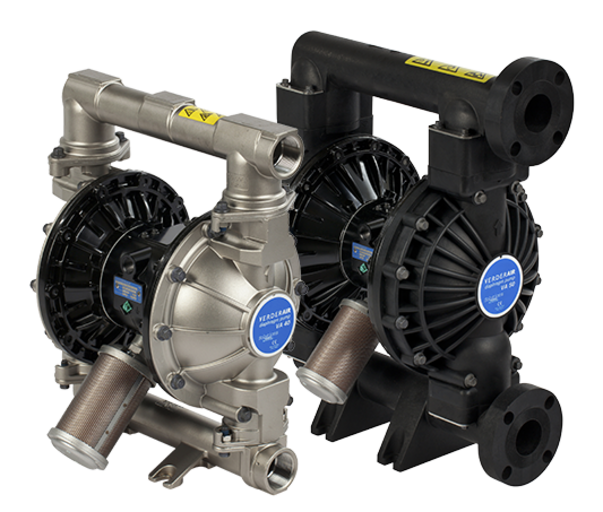
Verderair VA
Verderair VA Pumpen sind der Maßstab für Druckluftmembranpumpen. Die Baureihe ist mit einem schnell umschaltenden und blockierfreiem Luftsteuerventil ausgestattet,...
| Max. Fördermenge | 1200 l/min |
| Max. Förderdruck | 8,6 bar |
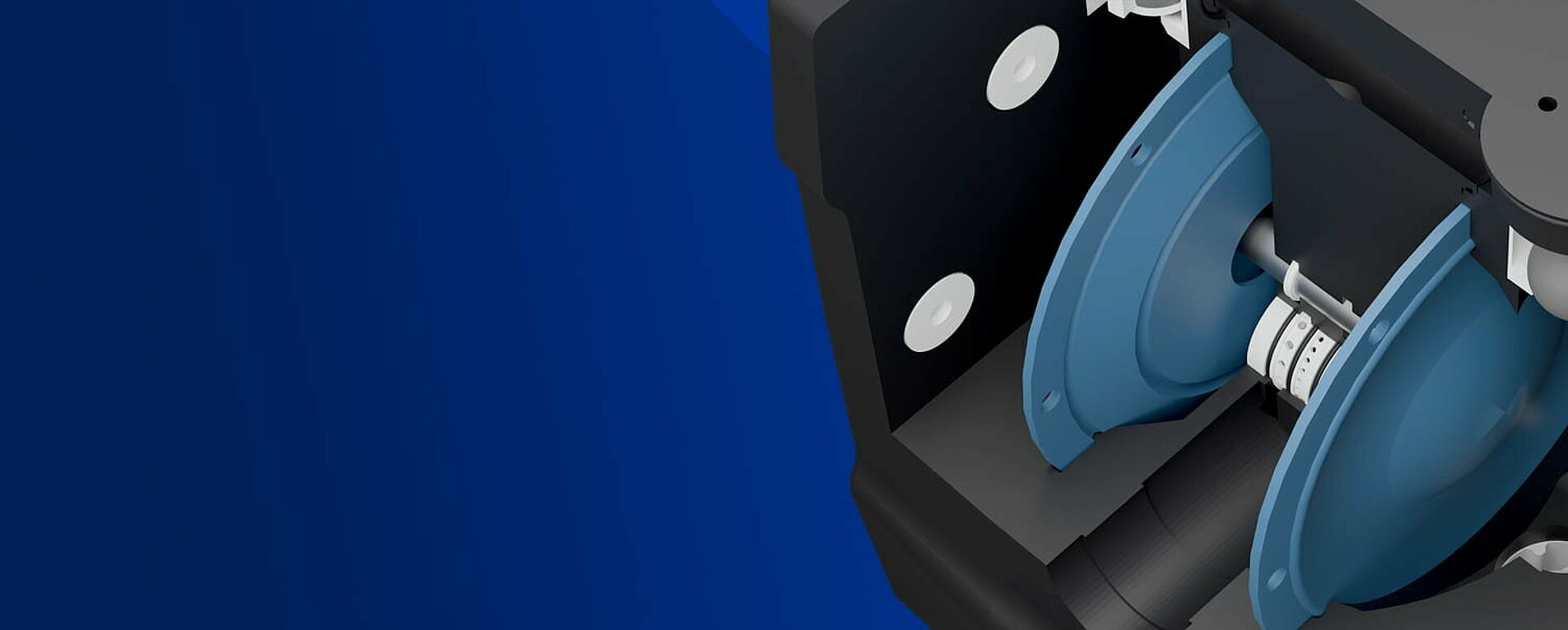
AODD- und EODD-Membranpumpen, entwickelt und hergestellt
im eigenen Haus von Verderair
Für chemische, hygienische und anspruchsvolle industrielle Flüssigkeitshandhabung in mehr als 20 globalen Märkten.
Eine Diaphagmpumpe, auch Membranpumpe genannt, ist eine Verdrängerpumpe, die es Anwendern in der Industrie ermöglicht, sich auf einen Pumpentyp zu standardisieren, der für eine Vielzahl von Flüssigkeiten geeignet ist. Die Membranpumpen von Verderair, die im eigenen Haus und nach den höchsten Standards der Branche hergestellt werden, sind in verschiedenen Materialien erhältlich, sowohl metallisch als auch nichtmetallisch, um allen spezifischen Anforderungen im Bereich der Flüssigkeitshandhabung gerecht zu werden, egal wie schwierig sie sind.
The Verderair range of industrial and hygienic diaphragm pumps is designed and manufactured in-house by Verderair for the applications where other pump types reach their limits. Concentrated acids, abrasive slurries, shear-sensitive foodstuffs, volatile solvents, and sterile pharmaceutical media all demand a pump with no shaft seal to leak, no rotating parts to degrade the fluid, and the flexibility to handle whatever your process throws at it. Available in metallic and non-metallic construction across a full range of material configurations, ATEX certified for Zone 1 and Zone 2 hazardous areas, and with hygienic models meeting FDA and EC 1935/2004 food contact material requirements, the Verderair range covers the duty points, fluid chemistries, and installation environments that define the most demanding industrial and hygienic fluid handling applications.
Want to understand how the pumping cycle works, what the air valve does, and how AODD and EODD technology differs in detail?
Our engineers are available to discuss your fluid type, flow rate, and process conditions and recommend the right Verderair configuration.
Verderair manufactures both air operated double diaphragm (AODD) and electrically operated double diaphragm (EODD) pumps. Both types share the same seal-less, self-priming, dry-run safe design. The difference is the drive mechanism, which has significant implications for energy efficiency, installation, and flow control.
| Factor | AODD (air operated) | EODD (electrically operated) |
|---|---|---|
| Power source | Compressed air | Electrically operated |
| Energy efficiency | 10–15% of input electrical energy reaches the pump | Up to 80% more efficient than equivalent AODD |
| Flow control | Adjustable via inlet air pressure | Precise control via VFD or integrated controller |
| ATEX / hazardous area | Inherently safe: no electrical parts in fluid zone | Available in ATEX version |
| Noise level | Higher: characteristic exhaust beat at each stroke | Significantly quieter: no air exhaust |
| Portability | Lighter and portable: no motor, no electrical connection required | Requires fixed electrical supply |
| Installation | Can operate submerged; flexible installation options | Fixed installation; requires power connection |
| Best for | Hazardous zones, portable duty, variable flow, aggressive chemicals | Continuous high-volume transfer, energy savings, precise dosing |
Verderair VA Pumpen sind der Maßstab für Druckluftmembranpumpen. Die Baureihe ist mit einem schnell umschaltenden und blockierfreiem Luftsteuerventil ausgestattet,...
| Max. Fördermenge | 1200 l/min |
| Max. Förderdruck | 8,6 bar |
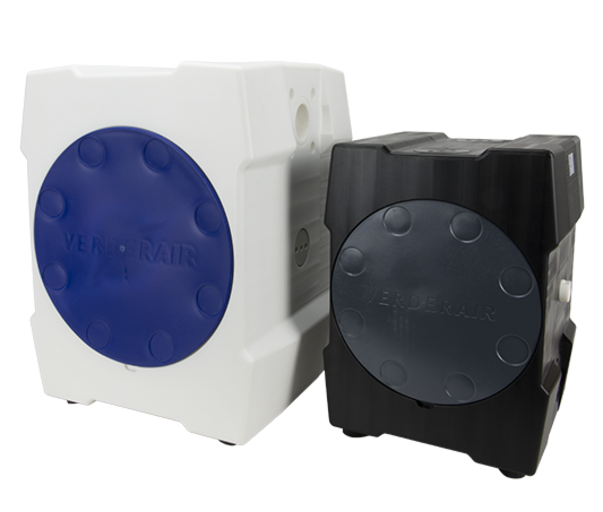
Die Konstruktion der Druckluftmembranpumpe Verderair PURE ist für den intensiven Einsatz, anspruchsvolle Chemikalien und schwierige Prozessbedingungen ausgelegt, wie...
| Max. Fördermenge | 660 l/min |
| Max. Förderdruck | 7 bar |
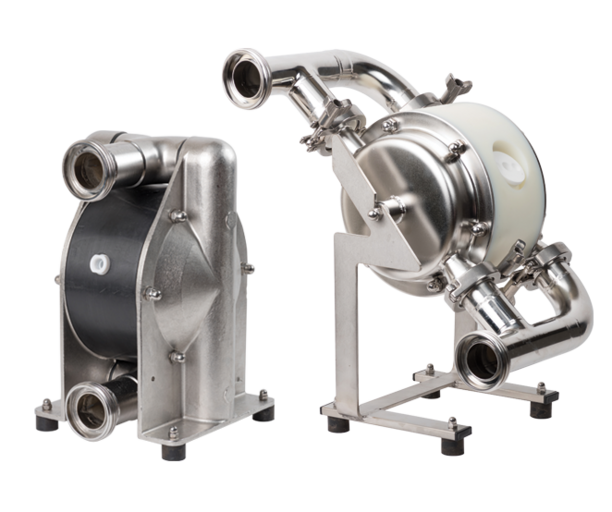
Die hygienischen Doppelmembranpumpen der Verderair HC-PURE-Serie sind für verschiedene Hygieneanwendungen konzipiert. Die elektropolierten Oberflächen verringern das...
| Max. Fördermenge | 465 l/min |
| Max. Förderdruck | 7 bar |
The diaphragm is the component in direct contact with your process fluid. Selecting the correct material is critical for chemical compatibility, service life, and process safety.
| Category | Material | Price level | Flex life | Abrasion resistance | Chemical resistance | Min temp (°C) | Max temp (°C) |
|---|---|---|---|---|---|---|---|
| Thermoplastic (TPE) | Hytrel | €€ | B | A | B | -20 | 120 |
| Santoprene | €€ | A | A | B | -40 | 100 | |
| Verderlast® | €€ | A | A | B | -20 | 100–120 | |
| PTFE | PTFE (2-piece) | €€€ | B | C | A | 0 | 120 |
| PTFE (Overmolded) | €€€€ | A | C | A | -10 | 120 | |
| Rubber | EPDM | € | B | B | B | -40 | 100 |
| EPDM (Overmolded) | €€€ | A | B | B | -10 | 100 | |
| Nitrile (Buna-N) | € | B | B | C | -10 | 80–90 | |
| Viton (FKM) | €€€ | C | D | A | -20 | 120 |
A = Excellent B = Good C = Fair D = Not recommended
The pump body material determines structural integrity, temperature tolerance, and resistance to the external process environment. Select based on your fluid chemistry and operating conditions.
| Category | Material | Price level | Mechanical strength | Abrasion resistance | Chemical resistance | Min temp (°C) | Max temp (°C) | Key limitations |
|---|---|---|---|---|---|---|---|---|
| Metallic | Aluminium | € | B | B-C | C | -20 | 100 | Corrosion risk with acids and alkalis; not for aggressive chemicals |
| Stainless steel (316) | €€ | A | B | A | -40 | 150 | Cost; chloride pitting possible | |
| Non-metallic | Acetal (POM) | €€ | B | B | A | -20 | 80–100 | Poor with acids and alkalis |
| Polypropylene (PP) | € | B-C | B | A-B | 0 | 80–90 | Limited temperature range; lower mechanical strength | |
| PVDF (Kynar) | €€ | B | B | A | -20 | 100–120 | More expensive than PP | |
| PTFE (Solid) | €€€ | C | C | A | 0 | 100 | Weak mechanically; usually lined, not structural | |
| UHMW-PE | €€ | B | A | A | -40 | 80 | Low temperature limit |
A = Excellent B = Good C = Fair D = Not recommended
The seal-less design of an air operated diaphragm pump eliminates shaft seal leakage risk when handling corrosive acids, alkalis, or solvents.
Recommended pump: Verderair PURE
Diaphragm pumps in chemical processing →
FDA-compliant materials and CIP/SIP compatibility make Verderair membrane pumps suitable for hygienic production environments.
Recommended pump: Verderair HC-PURE
Diaphragm pumps in food and beverage →
Verderair hygienic diaphragm pumps meet FDA and EC 1935/2004 food contact material requirements. The smooth, crevice-free internal design enables full CIP and SIP cleaning, making them the standard choice for hygiene-critical processes.
Recommended pump: Verderair HC-PURE
Zero contamination risk and full traceability of wetted materials for pharmaceutical production environments.
Lithium battery manufacturing relies on Verderair diaphragm pumps across multiple process steps requiring chemical resistance.
No close-fitting internal parts to wear against abrasive material. Hytrel diaphragms extend service life in abrasive slurry duties.
Self-priming, dry-run safe design for variable-flow and intermittent-duty water treatment applications.
The seal-less design of an air operated diaphragm pump eliminates shaft seal leakage risk when handling corrosive acids, alkalis, or solvents.
• Aggressive acid and solvent transfer
• Tanker and IBC unloading
• Filter press feed
• Polymer and additive dosing
• Electroplating bath transfer
Recommended pump: Verderair PURE
FDA-compliant materials and CIP/SIP compatibility make Verderair membrane pumps suitable for hygienic production environments.
• High-viscosity sauces and pastes
• Winery and brewery transfer
• Hygienic dosing and metering
• CIP return line pumping
Recommended pump: Verderair HC-PURE
Every Verderair diaphragm pump, whether for industrial or hygienic applications, is designed and built in our own facilities. Full control over quality, faster delivery, and a shorter supply chain for spare parts and service in all 20+ markets we operate in.
The full Verderair AODD range is available as a complete ATEX diaphragm pump package in Zone 1 and Zone 2 certified configurations. Both metallic and non-metallic body options are available in conductive materials to prevent static accumulation in solvent and flammable fluid applications.
The Verderair air valve prevents stalling even under moist compressed air or low air pressure. Anti-icing features ensure operation in cold or humid environments where condensation in the air supply would stall competing designs.
Metallic options in aluminium, cast iron, and stainless steel 316L alongside non-metallic options in PP, PVDF, and conductive PP cover chemical and hygienic duties across virtually any process fluid.
Local Verderair pump engineers are available for specification, installation support, and servicing. Genuine Verderair spare parts are stocked in each market for fast turnaround.
Verderair pumps are designed for extended diaphragm service life in continuous and intermittent duty. Our maintenance whitepaper covers the most common failure causes and how to prevent each one.
Use these three questions to identify the right Verderair configuration for your application.
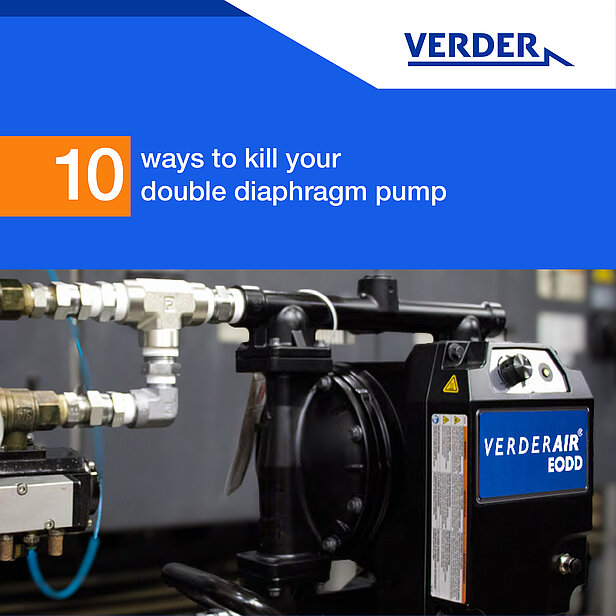
Curious about what you should be doing to preserve the life of your diaphragm pump? The following whitepaper has valuable insights into what can damage and even "kill" your diaphragm pump.
A compressed air system converts only 10–15% of its input electrical energy into useful work at the pump. An EODD pump eliminates the compressor entirely and can deliver up to 80% lower energy consumption than an equivalent AODD pump on the same duty. For continuous high-run-time transfer applications, the EODD typically delivers payback within 12 to 24 months.
The VA is a general-purpose AODD pump available in both metallic and non-metallic construction with a broad material choice. The PURE is engineered for the most aggressive chemical duties, with PTFE wetted parts throughout and a non-metallic body. For concentrated acids, strong oxidisers, or solvents requiring maximum chemical resistance, the PURE is the correct choice.
Yes. Standard Verderair VA models pass solids up to 9.4 mm. HC-PURE sanitary models accommodate solids up to 25 mm. Hytrel diaphragms are recommended for abrasive solids duties to maximise service life.
The Verderair range covers PTFE, EPDM, NBR (Buna-N), Hytrel, Santoprene, and Neoprene. PTFE is the standard recommendation for aggressive chemical and high-purity applications. Hytrel is preferred for abrasive slurries. EPDM and Santoprene cover food, beverage, and general industrial use.
Yes. The full Verderair AODD range is available as an ATEX diaphragm pump in Zone 1 and Zone 2 certified versions. Both metallic and non-metallic body options are available in conductive materials to prevent static build-up in solvent and flammable fluid applications.
The Verderair VA delivers up to 1,200 l/min at a maximum discharge pressure of 8.6 bar. Across the full range, models are available from below 10 l/min up to 1,200 l/min to match a wide variety of industrial duty points.
Our pump engineers are available across all major markets to support specification, selection, and installation. Whether you are replacing an existing pump, designing a hygienic process line, or evaluating diaphragm pump technologies for the first time, we can help.
Eine Membranpumpe arbeitet mit einer flexiblen Membran, die sich hin und her bewegt, um ein variables Volumen innerhalb der Pumpenkammer zu erzeugen. Wenn sich die Membran nach oben bewegt, erzeugt sie ein Vakuum, das Flüssigkeit in die Kammer zieht. Wenn sich die Membran nach unten bewegt, drückt sie die Flüssigkeit aus dem Auslassventil. Dieser Pumpentyp wird häufig wegen seiner Zuverlässigkeit und seiner Fähigkeit verwendet, verschiedene Flüssigkeiten ohne Verunreinigung zu fördern, da die Flüssigkeit nicht mit beweglichen Teilen wie Zahnrädern oder Kolben in Berührung kommt.
Unser Verderair-Sortiment besteht aus zwei verschiedenen Arten von Membranpumpen, druckluftbetriebenen Doppelmembranpumpen und elektrischen Membranpumpen. Wie der Name schon sagt, besteht der Hauptunterschied zwischen den beiden in der Art und Weise, wie sie funktionieren, wobei erstere mit Druckluft angetrieben wird, während letztere mit einem Elektromotor betrieben wird.
Brauchen Sie Hilfe? Unsere Pumpenexperten sind hier, um Ihre Fragen zu beantworten!
Unsere Membranpumpen zeichnen sich durch eine hohe Vielseitigkeit und Zuverlässigkeit bei der Förderung einer Vielzahl von Flüssigkeiten und unter unterschiedlichen Bedingungen aus. Zu den Anwendungen gehören